


Private Label Caviar: White-Label Solutions for Your Brand
By Alex Beleaev | Beleaev Caviar & Gourmet | beleaev.com
You run a luxury hotel. Or a premium airline. Or a speciality food retailer. And you've noticed something: the caviar you serve or sell carries someone else's name on the tin. Every time a guest admires it, someone else's brand gets the credit.
Private label caviar solves that problem. Your brand, your design, your story on the tin. Same exceptional product inside, but now it builds your equity instead of your supplier's.
The concept isn't new. Hotels have been doing it with champagne for decades. But private label caviar is growing fast as more luxury businesses recognise the opportunity.
Key Takeaways
- Private label (white-label) caviar lets you sell premium product under your own brand without operating a farm or processing facility
- Typical minimum order quantities start at 50-100 tins per SKU, depending on the supplier and level of customisation
- Full CITES compliance, including correct labelling, remains the legal responsibility of the brand owner as well as the producer
- Hotels, airlines, luxury retailers, and corporate gift companies are the primary users of private label caviar programmes
- Lead times of 4-8 weeks are standard for branded packaging production
How Private Label Caviar Works
The mechanics are straightforward, even if the execution requires care.
A private label supplier (sometimes called a white-label or contract-pack supplier) produces caviar at their processing facility using their sourced sturgeon roe. The product is identical in quality to what they sell under their own name or to other wholesale clients. The difference is the packaging.
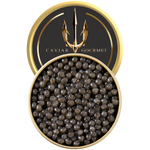
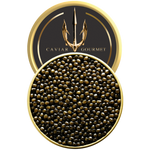
Instead of the supplier's branding, the tins carry your label. Your logo, your colour scheme, your brand story. The tin itself is standard (vacuum-sealed or press-fit, typically in 10g, 30g, 50g, or 125g sizes), but the exterior label and any outer packaging (boxes, sleeves, bags) reflect your identity.
Some suppliers offer deeper customisation. Bespoke tin colours. Embossed lids. Custom gift boxes with foam inserts. Branded service accessories like spoons or cooler bags. The level of personalisation depends on your volumes and your budget.
The supplier handles production, processing, quality control, and CITES documentation. You handle branding, marketing, and sales to your end customer. It's a partnership built on each party's strengths.
Who Uses Private Label Caviar?
The client base is broader than you might expect.
Luxury hotels are the largest users. A five-star property serving caviar at its restaurant, bar, and room service can move significant volumes. Having that caviar carry the hotel's brand reinforces the property's identity and creates a premium experience that guests associate directly with their stay. Some hotels also sell branded tins through their gift shops, turning an in-room amenity into retail revenue.
Airlines, particularly in first class and premium business lounges, have long used private label caviar. The tin with the airline's branding becomes part of the in-flight experience, frequently photographed and shared on social media. According to IATA, premium cabin passengers increasingly cite food quality as a deciding factor in airline loyalty, and branded caviar is one of the most visible signals of investment in that experience.
Speciality food retailers use private label to differentiate. Instead of competing on price with the same branded tins everyone else carries, a retailer's own-brand caviar becomes exclusive to their shop. This eliminates direct price comparison and allows for healthier margins.
Corporate gift companies build caviar into luxury hampers and client appreciation packages. Private labelling adds a layer of personalisation that off-the-shelf products can't match. A hedge fund sending branded caviar to its top clients makes a rather different impression than sending a generic tin.
Event and catering companies use private label for high-profile occasions. Weddings, galas, product launches, and fashion week events where every detail is curated.
Minimum Order Quantities and Pricing
MOQs are the first practical question every prospective private label client asks. The answer depends on what you're customising.
Labels only (your design printed and applied to standard tins): expect minimums of 50-100 tins per SKU. This is the lowest-commitment entry point and suits businesses testing the concept or with moderate volumes.
Custom outer packaging (branded boxes, sleeves, or presentation sets): minimums typically rise to 100-250 units because of printing setup costs. The per-unit cost drops significantly at higher quantities.
Fully bespoke tins (custom colours, embossed lids, unique shapes): these are the premium tier. Minimums of 500+ units are common, with lead times of 8-12 weeks. This level of customisation is usually reserved for established programmes with predictable annual volumes.
Pricing for private label caviar includes two components: the product cost (which aligns closely with standard wholesale rates) and the packaging premium. Labels add relatively little to the per-unit cost. Fully bespoke packaging can add £3-10 per unit depending on complexity and volume. At scale, the packaging premium per unit becomes negligible.
Most suppliers will provide a full cost breakdown during the quoting process. Compare the total landed cost (product plus packaging plus delivery) against your target retail price or internal cost allocation to ensure the margins work.
The Branding Process
Developing your private label caviar brand involves several stages.
Product selection comes first. Decide which species and grades you want to offer under your label. A hotel might want a single premium Oscietra. A retailer might build a three-tier range (Siberian, Oscietra, Beluga). An airline might need a specific tin size for in-flight service trays.
Taste the product thoroughly before committing. The caviar inside your branded tin becomes a reflection of your brand. If the quality disappoints, it's your reputation on the line, not the supplier's.
Label and packaging design is next. Work with your own design team or use a supplier's in-house design service if available. The label needs to include all legally required information: species, net weight, production date, best-before date, storage instructions, CITES labelling, allergen declarations, and your company details as the brand owner.
Proof approval. Review physical proofs, not just digital mockups. Colours look different on tin surfaces compared to screens. Check that text is legible at the actual size, and that the overall presentation meets your standards.
Production run. Allow 4-8 weeks from approved proofs to delivery for standard label programmes. Custom packaging adds time. Plan your first run well ahead of any launch date or seasonal peak.
CITES Compliance for Private Label
This section matters. Getting it wrong isn't just embarrassing; it's illegal.
All sturgeon caviar traded commercially requires CITES (Convention on International Trade in Endangered Species) compliant labelling. For private label products, the legal obligations don't transfer to the supplier simply because they produced the caviar. As the brand owner and seller, you share responsibility for ensuring the product reaching your customer carries correct documentation.
The CITES label must appear on each primary container (the tin). It must include the standardised species code, source code, country of origin, year of production, processing plant number, and lot identification. This information is typically printed on the tin lid or base label alongside your branding.
Your supplier produces the CITES labels as part of their processing facility registration. What you need to ensure is that these labels are correctly applied to your private label tins and that you retain batch records linking each lot back to the supplier's documentation.
If you're retailing private label caviar, be prepared for Trading Standards or Environmental Health inspections. Maintain a file of CITES documentation for every batch you've received. Your supplier should provide this routinely, but verify that you're actually keeping it organised and accessible.
For export outside the UK, additional CITES export permits may be required. Discuss this with your supplier and, if necessary, consult APHA (the Animal and Plant Health Agency) directly.
Quality Control Considerations
When your name is on the tin, quality control becomes your problem, even though production is your supplier's responsibility.
Establish clear quality specifications in writing before the first production run. Define acceptable ranges for egg size, colour, salt content, texture, and flavour. These specifications become the benchmark against which every batch is measured.
Request a sample from each production batch before it's labelled with your branding. Some suppliers facilitate this as standard; others require it to be written into the agreement. Either way, don't skip it. One substandard batch wearing your brand can undo years of reputation building.
Conduct periodic unannounced tastings of your own product purchased through normal channels. This is how you catch drift in quality that gradual familiarity might mask.
Shelf life management is crucial. Understand the production dates of your stock and ensure your sales channels move product well within its optimal window. Caviar sold past its peak doesn't carry the supplier's name. It carries yours.
Getting Started
The path from concept to branded tin is shorter than most businesses expect.
Start by contacting potential suppliers with a clear brief: what species, what volumes, what tin sizes, and what level of packaging customisation you're interested in. A serious supplier will respond with a detailed proposal covering product options, pricing tiers, minimum quantities, lead times, and sample availability.
Taste before you commit. Order samples of the products you're considering and evaluate them against your quality expectations. If possible, compare multiple suppliers.
Agree on terms. Standard wholesale payment terms apply to the product itself. Packaging setup costs (printing plates, die-cutting tools) may require an upfront deposit. Clarify who owns the packaging artwork and tooling.
Place your first order with realistic expectations. The initial run is a learning exercise. You'll refine label details, packaging logistics, and ordering rhythms over the first two or three cycles.
Further Reading
Shop the Beleaev caviar collection, responsibly farmed, CITES-certified, with next-day UK delivery.
Beluga · Oscietra · Baeri · Tasting Sets · Shop all
FAQ
What's the minimum investment to start a private label caviar programme?
At the entry level (custom labels on standard tins, 50-100 units), you're looking at a product investment of approximately £1,500-5,000 depending on species and tin size, plus £200-500 for label design and printing. Fully bespoke programmes with custom packaging start from around £5,000-10,000 for the initial run.
How long does it take from concept to finished product?
For a label-only programme using standard tins, allow 4-6 weeks from approved design to delivery. Custom packaging extends this to 8-12 weeks. Factor in design and approval time on your end, which can add another 2-4 weeks depending on your internal processes.
Do I need my own food safety certifications?
If you're storing and distributing the product, you need to be registered as a food business with your local authority. The production facility (your supplier's premises) holds the manufacturing certifications. But as the brand owner, you're responsible for ensuring the product meets all labelling, allergen, and food safety regulations at the point of sale.
Can I private label small quantities for a one-off event?
Some suppliers accommodate short runs for events, though per-unit costs will be higher. An alternative is branded outer packaging (boxes, sleeves) around standard tins, which requires lower minimums and faster turnaround. Discuss your specific needs with potential suppliers, as flexibility varies.
Interested in developing a private label caviar programme for your business? Speak with the trade team at Beleaev about custom branding, sampling, and supply.
For trade pricing, see our wholesale page or the full caviar range.
Beleaev Caviar & Gourmet is an international caviar and gourmet company sourcing responsibly farmed Baeri, Oscietra, Imperial and Beluga caviar, delivered within 24-48 hours. Next-day delivery across the United Kingdom.

 447706084493

