


Red Caviar vs Black Caviar: Everything You Need to Know
By Alex Beleaev | Beleaev Caviar & Gourmet | beleaev.com
Two jars on the same deli counter share a name and nothing else.
Black caviar comes from sturgeon. Red caviar comes from salmon, and is technically roe, not caviar at all. Different fish, different eggs, different price tag, and, as you're about to see, a gap in maturation time long enough to explain most of it.
Nine points of difference, one word doing far too much work.
Key Takeaways
- Black caviar comes from sturgeon; red caviar comes from salmon and is classified as roe, not caviar, under Codex Alimentarius standards.
- Egg size runs 2-3.5mm for sturgeon against 5-9mm for salmon.
- Sturgeon caviar commands a higher price because production takes years, yield is limited and trade is tightly regulated; salmon roe is generally more accessible.
- Sturgeon species are CITES-regulated; salmon roe is not.
Two fish, one word doing double duty
Black caviar is the salt-cured eggs of sturgeon species (Beluga, Oscietra, Sevruga, Baerii, and others). "Black" is a simplification: sturgeon eggs range from jet black to dark grey, olive green, brown, and even golden. But the dark colour is the iconic visual.
Red caviar is the salt-cured eggs of salmon species, most commonly chum salmon (keta), pink salmon (gorbusha), or sockeye salmon. In Japanese cuisine, it's called ikura (from the caviar term "ikra," meaning roe). The eggs are large, bright orange to deep red, and unmistakable.
Strictly speaking, only sturgeon eggs qualify as "caviar" under international food standards. Salmon eggs are roe, although the term "red caviar" is deeply embedded in Eastern European food culture and remains widely understood. What that single phrase hides is how differently the two products perform once you compare them feature by feature.
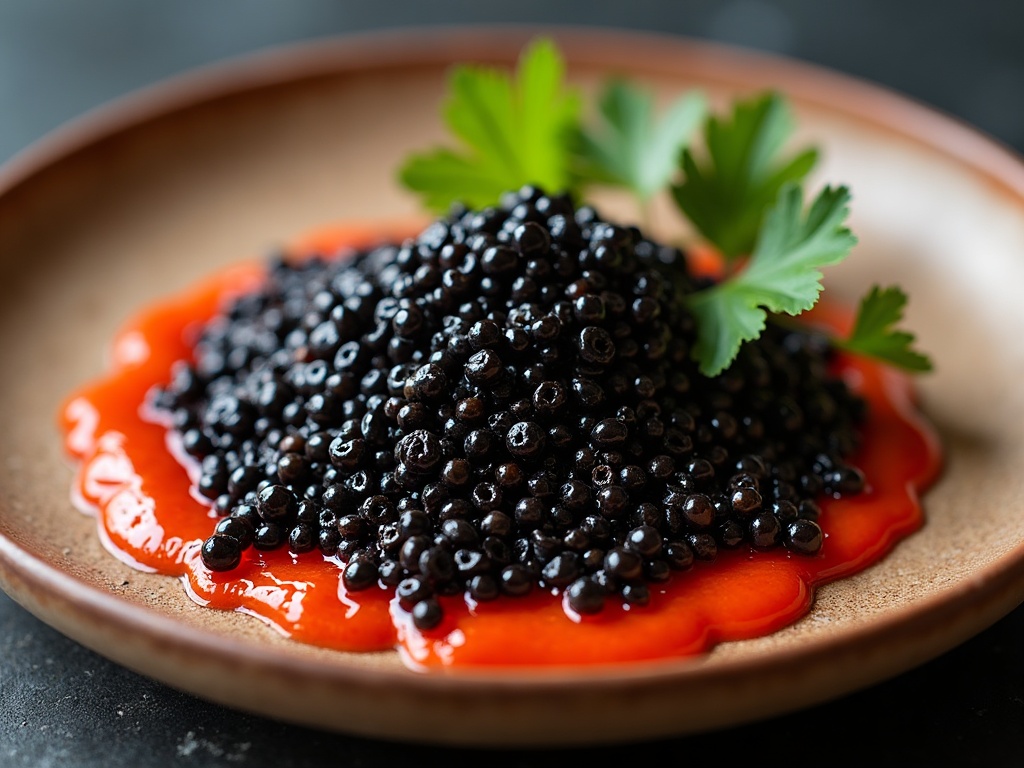
Nine ways they differ, side by side
| Feature | Black Caviar (Sturgeon) | Red Caviar (Salmon) |
|---|---|---|
| Source fish | Sturgeon (Beluga, Oscietra, Sevruga, Baerii) | Salmon (Chum, Pink, Sockeye, Coho) |
| Egg size | 2-3.5mm | 5-9mm |
| Colour | Black, grey, olive, brown, golden | Orange, red, deep crimson |
| Flavour | Complex: nutty, buttery, briny, creamy | Bold: briny, oceanic, slightly sweet |
| Texture | Delicate pop, silky dissolve | Firm pop, juicy burst |
| Salt content | 3-5% (malossol) | 4-8% (varies by preparation) |
| Price per 100g (UK) | Varies by species, grade and tin size | Generally more accessible |
| Shelf life (opened) | Follow the tin; enjoy promptly | 3-5 days |
| CITES regulated | Yes | No |
| Primary cuisine | French, Caspian, fine dining | Japanese, Caspian, Scandinavian |
Two rows on that table look like footnotes and aren't: flavour and texture. That's where the real divide sits, and where most people actually form their preference.
One note or a whole chord
The taste difference is substantial, not subtle.
Black caviar (taking Oscietra as our reference) opens with gentle brininess, then unfolds into butter, hazelnuts, and a long creamy finish. The flavour is layered and changes as the egg dissolves. There's an umami depth that lingers on the palate. Good Oscietra has what tasters call "complexity": you notice different things on the second and third bite.
Red caviar hits differently. The eggs are bigger, so the pop is more dramatic. A burst of salty, oceanic flavour fills your mouth immediately. There's a slight sweetness, especially with sockeye. The taste is bold, direct, and satisfying, but simpler. One note played loudly rather than a chord.
Neither profile is objectively superior. At Beleaev tastings, we've watched people gravitate strongly towards one or the other based purely on personal preference. Some find black caviar too subtle on first encounter and prefer the immediate impact of red. Others find red caviar too one-dimensional once they've experienced sturgeon eggs. Both reactions are valid, and both come down to the same physical fact: what happens in the half-second the egg meets the tongue.
The audible pop against the silky melt
Red caviar wins on drama. Those large eggs (chum salmon roe can reach 9mm) deliver a satisfying, almost audible pop. The liquid inside is generous, flooding the palate with flavour.
Black caviar is more delicate. The smaller eggs yield a gentler burst, followed by a silky, almost oily melt. The texture contributes to the overall impression of refinement and subtlety. It's more about the coating sensation on the tongue than the initial pop.
Texture preferences tend to be personal and persistent. We've noticed at tastings that people who love the big, juicy pop of salmon roe often continue to prefer it even after developing an appreciation for sturgeon caviar. It's a genuine sensory preference, not a lack of sophistication. What isn't a matter of preference, though, is the price gap that follows the two fish into the shop.
Why sturgeon caviar commands a premium
Compare current options rather than relying on a fixed market range: Wild Salmon XXL Roe offers generous bright pearls, while Oscietra Royal Caviar delivers the layered, nutty profile associated with fine sturgeon caviar. Species, pearl size, grade and tin size all influence the final price.
Maturation time. Salmon generally reach maturity far sooner than sturgeon. Depending on the species and farming conditions, sturgeon may require many years before producing caviar, so every tin represents a much longer investment in husbandry and care.
Scale and yield. Salmon is produced on a far larger global scale, while sturgeon caviar remains a specialist product with lower yields and a longer production cycle. That difference in availability is a major part of the price gap.
Regulation. All sturgeon species are CITES-listed. The compliance infrastructure for legal caviar trade, traceability systems, export permits, inspections, adds significant cost. Salmon roe carries no comparable regulatory burden.
Processing skill. Sturgeon caviar processing is more demanding. The malossol technique requires precision salting at 3-5%, careful temperature control, and rapid handling from harvest to tin. The margin for error is thin: over-salt by a single percentage point and a batch worth hundreds of pounds per kilo is ruined. None of those four forces, notably, touches nutrition, which turns out to be the one place the two fish come out almost level.
Nutritionally, almost a dead heat
Fish eggs in general are among the most nutrient-dense foods available, and on the numbers, black and red caviar sit close together.
| Nutrient (per 30g serving) | Black Caviar (Sturgeon) | Red Caviar (Salmon) |
|---|---|---|
| Calories | 75 kcal | 70 kcal |
| Protein | 7.5g | 7g |
| Omega-3 (EPA + DHA) | ~1,000mg | ~900mg |
| Vitamin B12 | ~6mcg (250% DV) | ~5mcg (210% DV) |
| Vitamin D | ~37 IU | ~45 IU |
| Selenium | ~18mcg | ~15mcg |
| Sodium | moderate | moderate |
Both are exceptional sources of omega-3 fatty acids. A single tablespoon of either provides more EPA and DHA than most fish oil supplements. The WHO recommends 250-500mg of EPA+DHA daily for cardiovascular health; one small serving of either caviar type covers that easily.
Red caviar edges ahead on vitamin D. Black caviar leads on B12 and selenium. Practically speaking, the nutritional differences are marginal, which leaves flavour, texture, and occasion to make the actual decision for you.
Which one belongs on your table tonight
This is where practical guidance beats abstract comparison.
Choose black caviar when:
- The caviar is the star. Served on its own, on blinis with just creme fraiche, or alongside Champagne.
- You want to mark a significant occasion. The ritual and presentation of sturgeon caviar carry a weight that salmon roe doesn't replicate.
- Subtlety matters. Pairing with delicate dishes where a bold flavour would dominate.
Choose red caviar when:
- You're building a dish. Salmon roe is excellent on sushi, poke bowls, pasta, scrambled eggs, and toast.
- Visual impact matters. Those large, glossy orange pearls are stunning as a garnish.
- You're feeding a crowd. The price point makes generous servings realistic.
- Japanese or Caspian cuisine. Ikura is integral to these traditions and performs exactly as intended.
At Beleaev, we recommend both for different occasions. Taste Wild Salmon XXL Roe for vivid colour and a generous pop, then compare it with Oscietra Royal Caviar for a layered, nutty finish. They are companions, not competitors, and the contrast is easiest to understand once you have tasted both.
Take a spoon of chilled Oscietra straight from the tin: the first note is a clean, briny pop, gone almost as soon as it arrives, and then butter and hazelnut spread slowly across the tongue, holding for a few seconds longer than expected. Follow it with a spoon of sockeye ikura, and the eggs burst all at once, a warm, oceanic rush that's sweeter and over faster. Same fridge, same spoon, two entirely different experiences of the word "caviar."
Taste the difference at your own table
Choose bold, bright Wild Salmon XXL Roe, refined Oscietra Royal Caviar, or compare sturgeon styles in a tasting set. Every order is delivered chilled across the UK.
Shop Wild Salmon XXL Roe · Shop Oscietra Royal Caviar · Explore tasting sets


The £3 jar that gives the fraud away
The markers of quality differ between the two, and knowing them protects the money you've just decided to spend.
For black caviar: Look for individual, glistening eggs that are uniformly coloured. The tin should not have excess liquid. Smell should be clean and oceanic. Taste should be briny first, then complex. Full CITES labelling is mandatory.
For red caviar: Eggs should be intact, firm, and uniformly sized. Colour should be consistent (avoid jars where eggs look dull or mixed in colour). Excess liquid in the jar suggests age or poor processing. Flavour should be clean and briny without any bitter or metallic aftertaste. Freshness matters enormously with salmon roe: it degrades faster than sturgeon caviar once processed.
A common pitfall: dyed lumpfish roe sold as either "black caviar" or "red caviar." These tiny, heavily salted eggs look nothing like the real product up close, but from a distance, or on a canape, they can fool the inattentive. The price is the clearest giveaway. If "caviar" costs £3 a jar, it's lumpfish. Once you can spot a fake, the more interesting question is why the two genuine products ended up living such different lives at the table in the first place.
Why one was for New Year and the other for diplomats
In the Caspian and across the wider region, red and black caviar occupy distinct cultural positions. Red caviar (krasnaya ikra) is celebratory but accessible: a fixture on New Year's tables, served generously on buttered bread or pancakes. Every family has it during the holidays. Black caviar (chornaya ikra) carries more prestige and was historically reserved for the elite, diplomats, and special occasions.
In Western Europe and the UK, "caviar" almost always means black, sturgeon caviar. Red caviar is known but less culturally embedded, unless you're eating Japanese food, where ikura has its own deep tradition.
Both cultural contexts are valid. Both sit inside centuries of food history that came long before either fish became a luxury commodity.
Further Reading
Shop the Beleaev caviar collection, responsibly farmed, CITES-certified, with next-day UK delivery.
Beluga · Oscietra · Baeri · Tasting Sets · Shop all
FAQ
Is red caviar cheaper because it's lower quality?
No. Salmon roe is generally more accessible because salmon mature sooner, production is far larger and there is no comparable CITES compliance burden. Quality Wild Salmon XXL Roe remains a premium product in its own right.
Can I substitute red caviar for black in recipes?
In some applications, yes. As a garnish or topping where you want visual impact and a pop of salinity, salmon roe works well. But for dishes where the caviar's subtle flavour is central (classical presentations with blinis and Champagne), the substitution changes the dish fundamentally. They're different ingredients, not interchangeable ones.
Which is healthier?
They're extremely similar nutritionally. Both are rich in omega-3 fatty acids, protein, B12, and selenium. Red caviar has slightly more vitamin D; black caviar has slightly more B12. The differences are marginal. Either is an excellent addition to your diet in moderate quantities. The main health consideration is sodium content, so portion awareness matters.
Is "black caviar" always from sturgeon?
Not always. Dyed lumpfish roe and paddlefish roe are sometimes marketed as "black caviar." Under EU and Codex Alimentarius standards, only sturgeon eggs can be labelled simply "caviar." Check for species identification and CITES labelling to confirm you're getting genuine sturgeon caviar. If the price seems too good to be true, it almost certainly is.
Red and black caviar aren't rivals. They're different expressions of one of nature's most remarkable foods: the fish egg. One is bold, generous, and democratic. The other is subtle, complex, and rare. Understanding the difference makes you a better eater, a smarter buyer, and a more interesting dinner companion.
Explore Beleaev's caviar and roe collections at beleaev.com
Explore the full caviar collection at Beleaev for next-day UK delivery.
Beleaev Caviar & Gourmet is an international caviar and gourmet company sourcing responsibly farmed Baeri, Oscietra, Imperial and Beluga caviar, delivered within 24-48 hours. Next-day delivery across the United Kingdom.
 447706084493

