
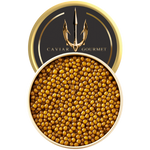
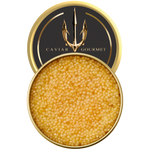
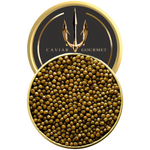
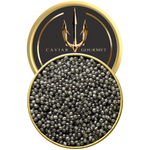


Almaz Diamond & Golden Caviar: The Rarest Tins Explained
By Alex Beleaev | Caviar & Gourmet, London | beleaev.com
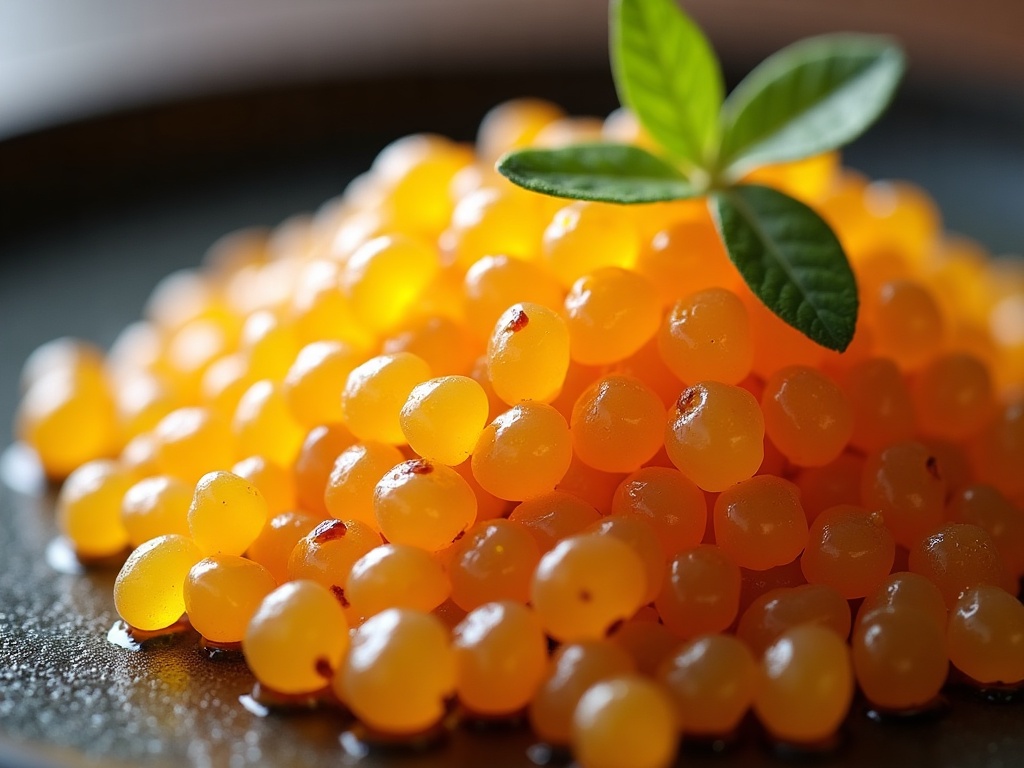
Golden caviar is not a flavour. It is a colour, and a rare one. The palest, most luminous tins on earth come from a handful of old or albino sturgeon whose roe ripens to gold instead of grey, and a single fish among thousands carries the trait. That is the whole reason these grades cost what they do. Everything else is detail.
The name people search for is Almas, Persian for diamond. Our own golden tin, Almaz Diamond, sits at the top of that lineage, alongside two more gold-graded reserves. Here is what the colour actually means, which sturgeon produce it, and how to read one of these labels without taking the word "rare" on trust.
Key Takeaways
- "Golden" caviar describes colour, not species; the gold appears only in certain old or albino sturgeon
- Almaz Diamond comes from the albino Bester sturgeon, a Huso huso and Acipenser ruthenus hybrid
- Pearl size varies by grade, from 1.5mm Almaz to 3.0mm Golden Oscietra
- Yields are tiny and selection is by hand, which is what sets the price
- Curious? Explore the Beleaev Special Reserve collection
What Makes Caviar Golden?
The short version: pigment, age and a rare bit of genetics.
In most sturgeon, roe matures to a grey, brown or charcoal tone. In a small number of fish, the pearls instead ripen to gold, amber or pale ivory. Sometimes that is down to age. The oldest Oscietra sturgeon, for example, produce lighter, more golden roe after twelve to fifteen years, which is why the gold grade is so much scarcer than the standard one.
And sometimes it is genetics. The rarest gold of all comes from albino sturgeon, where the fish lacks the pigment that would otherwise darken the eggs. The result is a pearl that reads as tender gold to golden-yellow, with a shimmer like the inside of a shell.
The flavour does not follow the colour in any reliable way. A golden pearl is not "better" because it is gold. It is rarer, more uniform, and frankly more photogenic, but the taste is governed by species, maturation and salting, just as it is for grey caviar. So treat colour as a mark of scarcity, not a guarantee of richness.
Almaz Diamond: Caviar From the Albino Sturgeon
This is the one people mean when they say Almas.
Almaz Diamond Caviar is drawn only from albino sturgeon, one of the rarest mutations in nature. A single fish among thousands carries the white pigment that produces golden, mirror-clear roe, so every tin is hand-graded for clarity and uniform colour. The species is a Bester Albino, a hybrid of Huso huso and Acipenser ruthenus, raised in spring-fed pools across Germany and China.
The pearls are small to medium and delicate, between 1.5 and 2.0 millimetres, with a luminous tender gold to golden-yellow shimmer that catches the light like mother of pearl. On the spoon, Almaz opens with a clean marine note and a quiet glassy crispness. The mid-palate brings hazelnut and a soft creme-fraiche centre, and the buttery finish holds for nearly a minute.
If you are weighing up where to start with the gold grades, this is the showpiece. From around £163, it is the tin to open when the occasion is the point.
The Gold Grades, Side by Side
Three of our tins carry the gold or diamond designation, and they are not the same caviar. Here is how they line up.
| Grade | Species | Pearl size | Colour | Maturation |
|---|---|---|---|---|
| Almaz Diamond | Bester Albino (Huso huso × A. ruthenus) | 1.5-2.0mm | Tender gold to golden-yellow | Spring-fed, hand-graded |
| Golden Oscietra Special Reserve | Acipenser gueldenstaedtii | 2.7-3.0mm | Light-gold to golden-amber | 12-15 years |
| Golden Kaluga Hybrid | Huso dauricus × A. schrenckii | 3.2-3.4mm | Radiant golden amber | 12-15 years |
Three different sturgeon, three different pearl sizes, one shared trait: a gold tone that only a fraction of each harvest ever reaches. The albino Almaz gives the smallest, most delicate pearl and the palest gold. The two reserves give larger pearls and a deeper amber, earned through age rather than genetics.
If you would rather taste the contrast than read about it, the Special Reserve collection gathers the gold grades in one place, and our companion guide compares the two big-pearled reserves in detail: Kaluga Hybrid vs Beluga XXL.
Golden Oscietra: The Shah's Caviar
Some grades earn their colour through patience.
Golden Oscietra Special Reserve is the most prestigious expression of Oscietra, long associated with the royal tables of Persia, where it was known as the Shah's Caviar. The grade is named for the rare luminous gold of its pearls, a colour that appears only in the oldest Acipenser gueldenstaedtii sturgeon, after twelve to fifteen years of slow maturation. Only the most mature fish produce gold-graded roe, selection is by hand, and the yield from each batch is small.
Each pearl is medium-to-large, between 2.7 and 3.0 millimetres, with a light-gold to golden-amber sheen that sets it apart from standard Oscietra. The flavour is rich and buttery, with warm toasted-hazelnut tones, a luminous golden depth and refined mineral elegance, finishing long and supple. The sturgeon is raised in certified aquaculture across China, France, Poland and Italy.
From around £51, it is the most approachable way into the gold grades, and a natural step up for anyone who already loves a classic Oscietra.
How to Recognise a Genuine Gold Tin
A few checks separate a real gold grade from a hopeful description.
The colour should be even, not patchy. Hand-graded gold roe is selected pearl by pearl, so a genuine tin reads as a uniform tone, whether that is the pale gold of Almaz or the deeper amber of a reserve. Mixed grey-and-gold pearls suggest the grading was loose.
The species should be named. Gold is a colour that appears across several sturgeon: the albino Bester for Almaz, Acipenser gueldenstaedtii for Golden Oscietra, the Huso dauricus cross for Golden Kaluga. A tin that says only "golden caviar" with no species is telling you very little.
The cold chain should be intact. At this level the texture is everything. Caviar is fresh and minimally processed, kept at -2 to +2 degrees, and it should arrive cold, never warm. The tin you open should look like the one that was packed.
Be realistic about scarcity. Albino sturgeon are a one-in-thousands event, and gold-graded reserve roe comes only from the oldest fish. That rarity is the price. A "golden caviar" sold like an everyday tin is usually neither rare nor gold-graded.
What to Serve With a Golden Tin
Keep it quiet and let the caviar speak.
These are tins for tasting, not for burying under garnish. Serve slightly cool, around 6 to 8 degrees on the palate, straight from a non-reactive spoon: mother of pearl, bone or horn, never metal, which turns caviar bitter. A warm blini, a little creme fraiche, perhaps a chilled Blanc de Blancs or an ice-cold neat vodka to cut the richness. Nothing acidic directly on the pearls.
For a true side-by-side, taste a small spoon of each gold grade in order of pearl size, from the delicate Almaz up to the larger reserves. The shift in texture and depth is the whole point of owning more than one.
FAQ
What is Almas caviar?
Almas means diamond in Persian, and the name is used for the palest, most golden caviar, drawn from albino sturgeon. Our Almaz Diamond follows that lineage: roe from the albino Bester sturgeon, hand-graded for mirror-clear, golden-yellow pearls of 1.5 to 2.0 millimetres.
Why is golden caviar so rare?
Because the gold colour appears in only a fraction of fish. In albino sturgeon it is a one-in-thousands genetic trait, and in Oscietra and Kaluga the gold tone develops only in the oldest animals, after twelve to fifteen years. Selection is by hand and the yield from each batch is small.
Does golden caviar taste different from black caviar?
Not because of the colour. Flavour is governed by species, maturation and salting, not pigment. Golden grades tend to be prized for rarity, uniform pearls and presentation. The taste, whether buttery, nutty or marine, depends on the sturgeon and the salting, exactly as it does for grey caviar.
Which golden caviar should a beginner try first?
Golden Oscietra Special Reserve, from around £51, is the most approachable gold grade and a natural step up from a classic Oscietra. For a showpiece tin, Almaz Diamond gives the palest, most delicate pearls and the full diamond experience.
Open a Golden Tin
Reading about gold pearls only gets you so far. The point is the first spoon: the shimmer, the clean marine note, the buttery finish that lingers.
Explore the Beleaev Special Reserve collection and the wider caviar collection, from the albino Almaz Diamond to the regal Golden Oscietra Special Reserve. Every tin is responsibly farmed, hand-graded, and delivered on a cold chain across the UK.


 447706084493

