
Blinis
£5.00
4.82/5 · 38 reviews
£5.00

£8.00

£6.00

£23.90

By Beleaev Family | Beleaev Caviar & Gourmet | beleaev.com
Baked potato with caviar sounds wrong on paper. A Tuesday-night British supper food paired with the most expensive ingredient in the deli. But the moment you eat it, you understand exactly why this is one of the great Caspian classics.
The fluffy starchy interior of a properly baked potato is the perfect canvas for sour cream and caviar. The hot earthy potato softens the cold cream, the cream lifts the salinity of the caviar, and the crisp skin gives you a textural anchor for each bite. It's better than any blini or canapé.
This is also the recipe that turns a single tin of caviar into dinner for two, rather than starter for four. A 30g spoon of Oscietra on a properly baked Maris Piper is more satisfying than the same caviar on six fiddly canapés.
Key Takeaways
- Use floury potatoes (Maris Piper, King Edward), never waxy
- Bake at 200C for at least 75 minutes for proper fluffy texture
- Salt the skin before baking for the crispest finish
- Cut a cross in the top, not lengthways, to avoid rapid heat loss
- Top with butter first, sour cream second, caviar third (in that order)
Serves 2
The potato variety matters. Maris Piper and King Edward are the proper baking potatoes, with high starch and low moisture. They produce fluffy interiors that turn into clouds when fluffed with a fork. Avoid Charlotte, Anya, or any waxy potato, the texture will be wrong.
Get potatoes that are the same size, around 350g each. This ensures even cooking. Smaller potatoes finish before the larger ones do, leaving you with one perfect potato and one underdone.
Preheat the oven to 200C (180C fan). Wash and scrub the potatoes thoroughly under cold running water. Dry them completely with a clean tea towel.
Prick each potato 6-8 times all over with a sharp fork. This lets steam escape and prevents the potato from exploding (which does happen).
Rub the skin of each potato with olive oil, then sprinkle generously with sea salt. Press the salt into the oil so it sticks. The salt-and-oil layer is what gives you the crispy skin everyone fights over.
Place the potatoes directly on the middle oven rack, not on a tray. Bake for 75-90 minutes, depending on size. The skin should be deep golden and crisp, and a sharp knife should slide through to the centre with no resistance.
Don't open the oven door for the first hour. Heat fluctuation extends the cooking time and softens the skin.
To check doneness, squeeze the potato gently with an oven glove. It should yield easily, almost squishy. If it still feels firm, give it another 10 minutes.
Take the potatoes out of the oven and rest for 2 minutes. The brief rest allows steam to redistribute internally.
Cut a deep cross into the top of each potato, around 4cm long in each direction. Don't slice the potato in half lengthways, you'll lose all the heat in 60 seconds.
Squeeze the potato gently from the bottom with both hands to push the cross open. Fluff the exposed interior with a fork, lifting the soft centre into a cloud-like mound that sits proud of the skin.
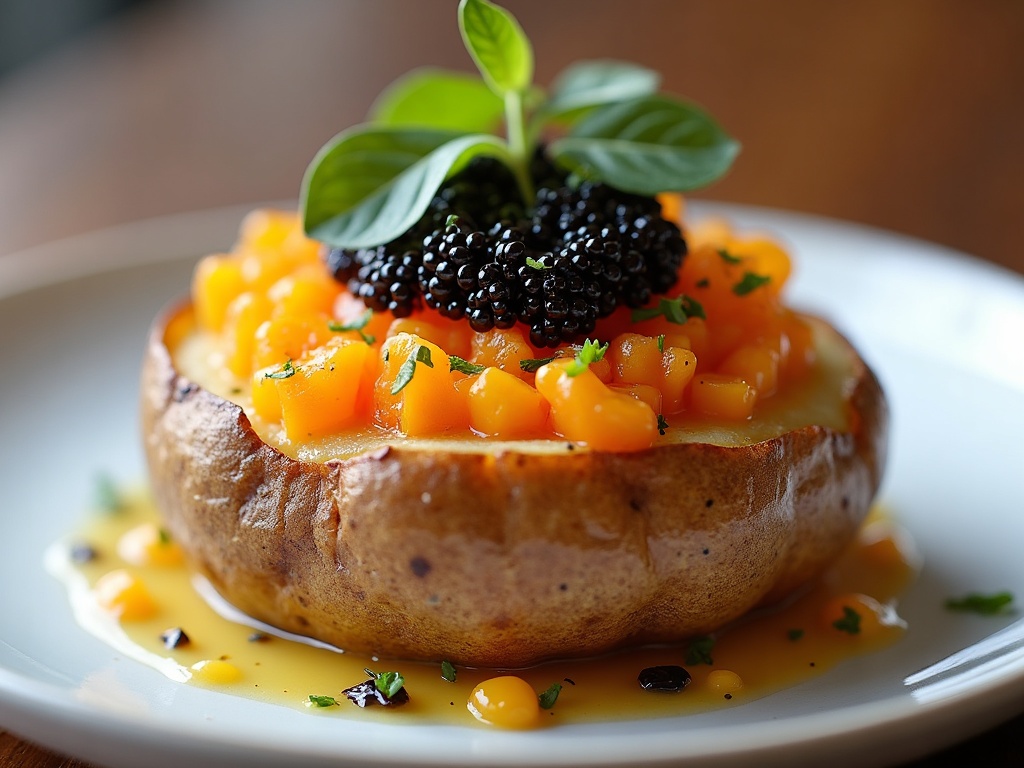
Drop a knob of cold butter (around 15g) into the fluffy interior of each potato. Let it melt for 30 seconds.
Add a generous dollop of sour cream, around 50g per potato. Don't spread it, leave it as a peak. The cream will slowly meet the melted butter.
Top with caviar, around 15-20g per potato. The caviar goes on top of the sour cream, never directly on the hot potato. Sour cream is your thermal barrier.
Scatter chives and a tiny pinch of flaky sea salt. Crack a small amount of black pepper at the edge, not on the caviar. Serve immediately, with a small spoon for eating.
Don't wrap in foil. Foil traps steam and gives you a soft skin, the opposite of what you want. Bake naked on the rack for proper crispy skin.
The cross cut, not the slice. Cutting lengthways turns your potato into two halves and lets all the heat escape. The cross cut keeps the potato as one vessel and lets you mound the fluffy interior up.
Sour cream BEFORE caviar, always. The cream creates a barrier between the very hot potato interior (often 90C+) and the cold caviar. Without it, the heat from the potato will partially cook the caviar and turn it chalky within seconds.
Don't go small on the caviar portion. 15-20g per potato is generous. Less than that gets lost in the volume of potato and cream, and you're not really tasting it. Better to use a more affordable variety (Kaluga, Baerii) at proper portion than a luxury variety (Beluga) at a stingy portion.
Eat with a small spoon. Knife and fork is wrong for this dish. A small dessert spoon lets you scoop a bit of the crisp skin, fluffy interior, melted butter, sour cream, and caviar all in one bite. That's the architectural idea.
With Beluga: Use 25g of Beluga per potato and reduce the chives. The most delicate caviar deserves cleaner accompaniments. This is the version we serve at private dinners when the guest is a caviar enthusiast.
With Kaluga: 25g of Kaluga per potato. The buttery character of Kaluga pairs beautifully with the melted butter on the potato. Discover Royal Imperial at Beleaev.
With smoked salmon: Add 30g of cold-smoked salmon to each potato alongside the caviar. The smoke and the brine work together wonderfully.
With trout roe: A more affordable substitute. Use 50g of trout roe per potato. The flavour is sweeter and less briny than sturgeon caviar but still delivers the textural pop.
Wine pairing: A glass of dry champagne or a flinty white Burgundy. Avoid red wine, even light reds, the tannins clash with the caviar. Frozen vodka is the Caspian alternative.
For more on caviar pairings and serving, see our caviar etiquette guide and our classic caviar platter post.
Floury potatoes (Maris Piper, King Edward) have high starch content and break down into fluffy clouds when cooked. Waxy potatoes (Charlotte, Anya) hold their shape and remain dense, which is what you want for salads but not for baking. The cloud-like texture of a floury potato is what catches the melted butter and creates the contrast with the cold caviar topping.
Technically yes, but you lose the crispy skin entirely. A microwaved baked potato has a steamed-soft skin that doesn't contrast with the fluffy interior. If you must speed things up, microwave for 6 minutes then transfer to a 220C oven for 20 minutes to crisp the skin. Better yet, plan ahead.
Crème fraîche is the closest substitute and arguably better, denser and tangier than UK supermarket sour cream. Greek yogurt also works in a pinch but the flavour is sharper. Avoid low-fat or "lite" versions of any of these, you need the full fat to create the proper texture and the thermal barrier between potato and caviar.
For a baked potato, 15-20g of caviar per person is the right portion. This is generous compared to canapé portions (3-5g per piece) but appropriate for the volume of potato underneath. For two people sharing one large potato as a snack, 25g of caviar across the single potato is enough.
There's a quiet pleasure to a baked potato with caviar that no canapé can match. The hot earthy potato, the cool sour cream, the cold pop of pearls. It's the dish that turns a Tuesday into something properly festive.
Discover Beleaev's caviar collection, the perfect topping for a baked potato dinner, at beleaev.com.
Beleaev is an international caviar and gourmet food company with fulfilment hubs across the UK, Europe, the UAE, and the United States. We are committed to sourcing responsibly farmed, sustainable products and delivering them to customers within 24 to 48 hours, ensuring exceptional freshness and quality.


 447706084493


